
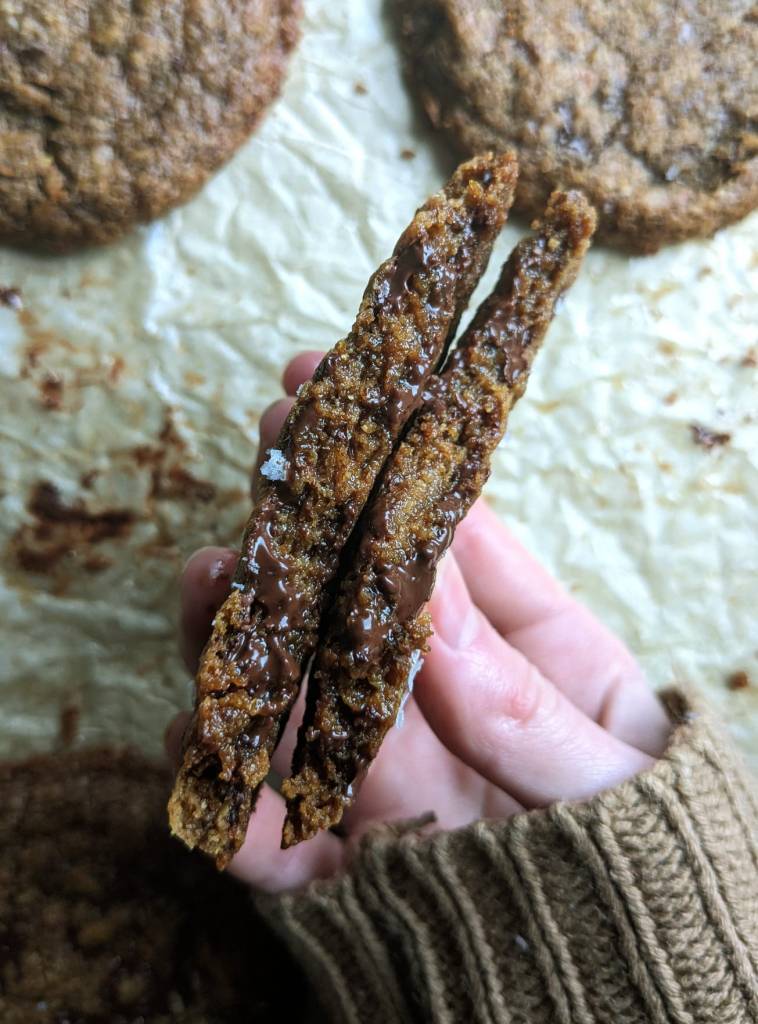
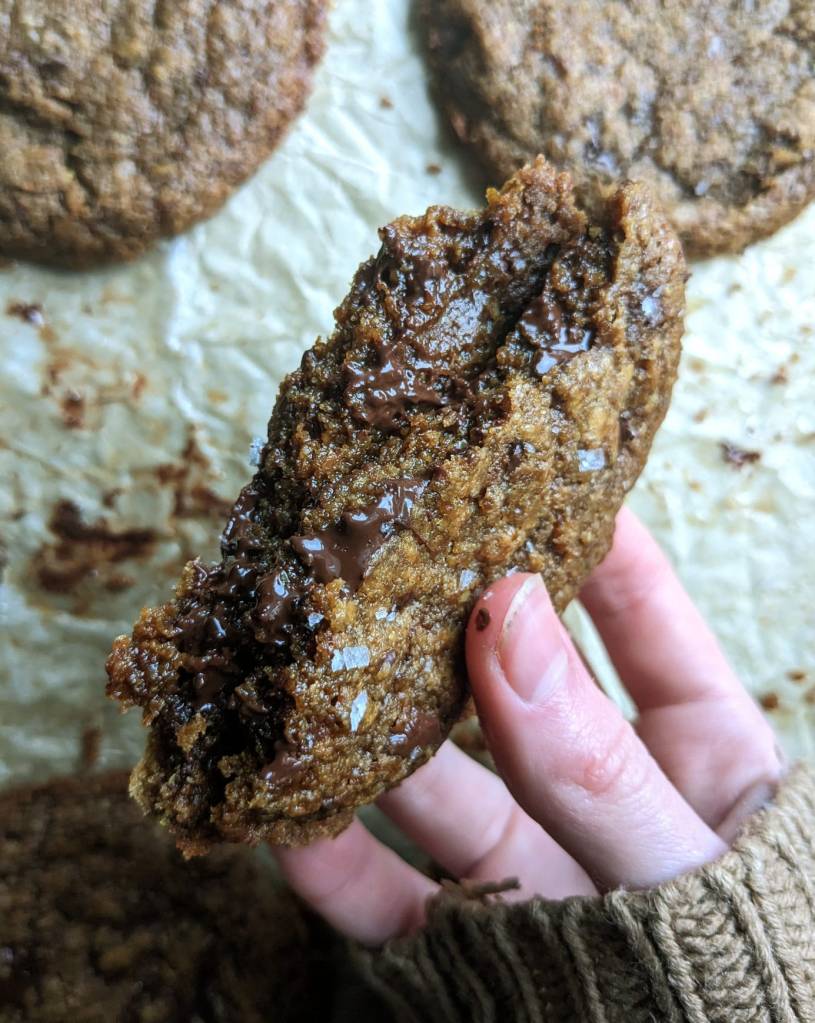
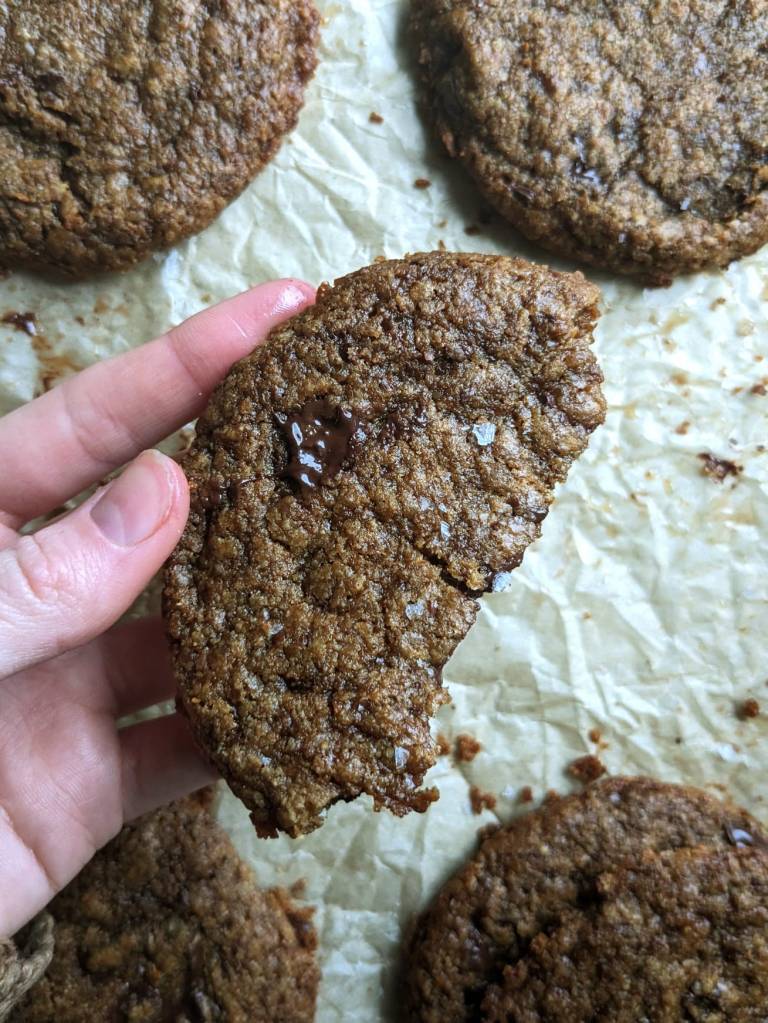
This may just be my favourite cookie recipe, in the world. Not only are they chewy, soft and slightly crisp, they are fully vegan, gluten-free and refined sugar free! They use no butter, no flour, and zero refined sugar. If your new years resolution is to follow a more plant focused/wholesome diet, these cookies are for you.
To achieve that classic cookie texture, I used oat flour which provides a wonderful stable and crunchy texture, whilst providing a deeper, rich flavour. To make them chewy, I use softened coconut oil in place of butter, which not only provides the cookies with the perfect texture, but it also gives a subtle coconut flavour to the cookies! Coconut sugar is used as my choice of unrefined sugar, it creates a caramel-like flavour which pairs well with the dark chocolate and orange zest.
If you found this recipe to your liking, check out my other biscuit recipes ↓


If you enjoyed this recipe, don’t forget to subscribe to my newsletter to receive all of my latest recipes straight into your inbox, for free. You can also follow my Instagram, YouTube and TikTok to see my baking videos and sneak peeks of my newest bakes.
Equipment & Ingredient notes
Equipment needed:
- Large mixing bowl
- Handheld electric whisk / stand mixer
- Cookie sheets
- Spatula / wooden spoon
- Measuring cups
- Measuring spoons
Ingredient list:
- Coconut oil ~ use unrefined coconut oil, however refined will provide the same results.
- Coconut sugar ~ use pure, unrefined coconut sugar, this can be substituted for brown sugar if necessary.
- Aquafaba ~ this is the liquid residue from canned legumes which provides similar properties when used in baking, best found in canned chickpeas but lentils also work.
- Vanilla ~ use high quality vanilla for the best outcome.
- Orange zest ~ this will provide the orange flavour, it can be skipped if desired, use a micro-plane zester for even zesting.
- Flax meal ~ this will bind the cookie together, you can make it yourself by blending flax seeds until a rough powder.
- Oat flour ~ this is just blended up oats, you can make it yourself if preferred.
- Baking soda ~ this will allow the cookie to spread evenly.
- Salt ~ this will enhance the flavour of the cookie, sprinkle on flaky sea salt at the end too!
- Plant chocolate ~ use 50%-70% for the best taste, use unrefined or make your own.
Step-by-step Instructions
(this is a summary, detailed version is attached to the recipe below)
- Add softened coconut oil and coconut sugar to a large bowl.
- Beat with an electric whisk until smooth.
- Add the vanilla, orange zest, aquafaba and flax meal.
- Beat again until combined and smooth.
- Add the oat flour, baking soda and salt to the bowl.
- Fold to briefly combine, flour streaks will remain.
- Add the chocolate chunks, fold until fully combined.
- Divide the dough into 8 equal balls.
- Place in a lined container and freeze for 15 minutes.
- Pre-heat the oven to 180c/160c fan while the cookies chill.
- Place the cookies on 2 lined baking sheets.
- Bake for 15 minutes until flattened and slightly crisp.
- Let cool on the trays and top with flaky sea salt.
- Enjoy, warm with ice-cream or fully cooled!
The History of Cookies
Cookies place of origin is in Persia where they date back as early as the 7th century AD. Persia was one of the first countries ever to grow and harvest sugar cane. Cookies are thought to have started off being an oven temperature tester. So many bakers would bake what are now known as ‘cookies’ to test if the oven temperature was right, before putting their baked good into the oven.
By the 14th century, cookies had spread through out the whole of Europe and were enjoyed by all levels of society, from royal cuisine to street venders.
Cookies were first introduced to America by the English in the 1600s. At this time, cookies went by many names like small cakes, seed biscuits, and tea cakes. Cookies got their name as we know it today in America.
Cookie storage – the baked cookies will keep fresh for about 4 days, sealed at room temperature. you can also freeze the cookie dough before baking, they will last up to 3 months and you can bake them at any time without defrosting!

Vegan, gluten-free, wholesome orange chocolate cookies
prep time: 15 mins / serves: 8 / cook time: 15 mins
- ingredients
- 1/2 cup coconut oil, softened
- 1 cup coconut sugar*, unrefined
- 2 tsp vanilla
- 3 tbsp aquafaba*
- 1 tbsp orange zest
- 2 tbsp flax meal*
- 1 + 3/4 cups oat flour*
- 1 tsp baking soda
- 1/2 tsp salt, flaky for topping
- 1/3 cup plant chocolate chunks, 50%
- method
- prepare 2 cookie sheets and a container with parchment paper.
- chop up the dark chocolate into chunks (1/3c), set aside.
- to begin the dough, add the softened coconut oil (1/2c) and coconut sugar (1c) to a large mixing bowl.
- beat with an electric whisk until fluffy and combined.
- add the vanilla (2tsp), orange zest (1tbsp), aquafaba (3tbsp) and flax meal (2btsp) to the bowl.
- whip again until fully combined and smooth.
- add the oat flour (1+3/4c), baking soda (1tsp) and salt (1/2tsp).
- fold in the dry ingredients until briefly combined.
- add the vegan chocolate chunks (1/3c) to the bowl.
- fold until fully combined, the dough will hold together but should not be sticky.
- with a cookie scoop, divide the dough into 8 equal balls.
- place the balls in the prepared container, freeze for 15 mins.
- in the meantime, pre-heat the oven to 180c/160c fan oven.
- divide the balls between 2 lined cookie sheets, place in the oven.
- bake for 15 mins until soft in the middle, crisp on the edges.
- whilst the cookies are hot, scoot them in a large cookie cutter to create a perfect circular cookie.
- sprinkle with a pinch of flaky sea salt and let cool completely on the tray, or enjoy warm with plant ice cream!
NOTES
- pure coconut sugar has a beautiful caramel flavour and is personally my favourite unrefined sugar, brown sugar can be used instead.
- aquafaba typically comes from the liquid residue of canned chickpeas, however it comes from any canned legumes, it is strongest in chickpeas but lentils also work.
- flax meal binds the cookie together, chia can be substituted here.
- you can make your own oat flour by blending oats until a flour.
 butterfly bakery blog
Leave a comment